
.svg)
.svg)
.svg)
.svg)
.svg)
.svg)
.svg)
.svg)
.svg)
.svg)
.svg)
.svg)
.svg)
.svg)
.svg)
.svg)
.svg)
.svg)
.svg)


%201.svg)

%201.svg)


Find out how biosolids use as fertilizer benefits soil and crops, what concerns it raises, and how its risks can be managed.
Using biosolids as fertilizer returns valuable nutrients and organic matter from wastewater to agricultural soils. When properly treated and applied, it may support crop production, improve soil properties, aid land rehabilitation, and reduce fertilizer costs. However, biosolids vary in quality, and their suitability for application depends on their source, treatment, contaminant levels, application rate, site conditions, and applicable regulations. This guide examines how biosolids fertilizer is produced and used, its potential benefits, and the risks that must be managed.
What is Biosolids Fertilizer?
A fertilizer product made from biosolids is derived from treated sewage sludge that meets applicable standards for land application as a source of plant nutrients or soil amendment. It may supply nitrogen, phosphorus, organic matter, and micronutrients while improving properties such as soil structure and water-holding capacity. However, its composition, quality, and permitted uses vary depending on wastewater inputs and the treatment processes used at the facilities it originates from.
Biosolids originate as solids separated during the treatment of domestic sewage. Before being used on land, these solids undergo processes that stabilize organic matter, reduce pathogens and vector attraction, and often reduce odor. Depending on the treatment and final solids content, the resulting product may be applied as liquid biosolids, dewatered cake, dried pellets, compost, or a blended soil product containing biosolids and materials such as bulking agents or other amendments. Application rates are generally based on crop nutrient needs, product analysis, soil conditions, and regulatory limits.
The agricultural use of human waste has a long history, but modern biosolids management is fundamentally different from the direct application of untreated sewage or sludge. Treatment processes reduce pathogens, odors, and the material's attraction to disease-carrying organisms, while testing and regulatory controls help manage pollutants and application practices.
Among the various regulatory approaches used internationally, the United States' federal biosolids framework is one of the most widely recognized benchmarks for understanding the controls that support the land application of biosolids. Under the federal 40 CFR Part 503 rule, also known as the US biosolids rule, requirements for using biosolids as fertilizer include pollutant limits, pathogen reduction, vector-attraction reduction, management practices, monitoring, and recordkeeping. In the US, biosolids are categorized as Class A or Class B based on pathogen levels, while Exceptional Quality biosolids must meet additional pollutant and vector-attraction requirements.
Benefits of Using Biosolids as Fertilizer
Biosolids have been studied for a variety of benefits, but outcomes depend on the quality upstream sludge treatment, receiving soil conditions, and the application rates. The following section highlights studies demonstrating the positive impacts of biosolids:
Recycles Nitrogen and Phosphorus
Biosolids recycle nutrients by returning nitrogen and phosphorus originally from food and human waste to agricultural soil. . During wastewater treatment, a portion of the nitrogen and phosphorus is captured in sewage solids.
Once the solids are treated to meet applicable standards, land-applied biosolids return these captured nutrients to the soil. Other portions may leave the treatment system in the effluent or, in the case of nitrogen removal, as nitrogen gas.[
In the soil:
- Nitrogen occurs mainly in organic compounds and ammonium. Soil microorganisms gradually convert organic nitrogen into ammonium and then nitrate, which crops can absorb. This slow release of nitrogen can supply nitrogen over several growing seasons.
- Phosphorus occurs in both organic and inorganic forms. Microbial decomposition and soil reactions release some of it as plant-available phosphate, while the remainder is retained in the soil and may serve as a longer-term nutrient reserve.
A 2026 Washington State study on biosolids fertilizer illustrates this benefit in practice. Brown and colleagues compared municipal biosolids with conventional fertilization using a long-term field trial and a full-scale biosolids program for dryland wheat. Biosolids increased wheat yields by approximately 14%, demonstrating that nutrients recovered from wastewater can support commercial crop production.
Adds Organic Matter to Soil
Unlike most mineral fertilizers, biosolids add carbon-rich organic matter to the soil. This organic matter can improve soil structure, biological activity, and the soil's ability to retain water and nutrients, potentially supporting crop productivity and resilience to drought and erosion.
A 20-year California study found greater soil organic carbon in biosolids-amended soils than in nearby unamended soils at three agricultural sites. Across the full one-meter soil profile, the estimated increase in carbon stocks ranged from approximately 0.2 to 0.5 metric tons of carbon per hectare per year.
Retaining carbon in soil can contribute to climate change mitigation. Still, the overall climate benefit depends on how long the carbon remains stored and the emissions associated with biosolids treatment, transport, application, and decomposition.
Improves Soil Structure and Water-Holding Capacity
Biosolids add organic matter that can help soil particles bind into stable aggregates. Better aggregation creates a more open soil structure, allowing water to infiltrate and roots to grow more easily. Because organic matter can retain water, biosolids may also increase soil moisture and the amount of water available to plants, which is an especially useful benefit in dryland agriculture.
Biosolids can also reduce soil bulk density, making the soil less dense and more porous. This occurs partly because organic material is less dense than mineral particles and partly because improved soil aggregation increases pore space. Lower bulk density can support root penetration, drainage, and gas exchange, although the effect depends on soil texture, application rate, biosolids properties, and subsequent compaction.
A long-term field study in semi-arid cropping systems in Washington and Colorado found that repeated biosolids applications increased water retention and reduced bulk density, with the strongest effects observed at the Washington site.
Supports Land Rehabilitation
Biosolids can help revegetate land degraded by mining, construction, severe erosion, wildfire, or other disturbances. Such sites often struggle to support plants because their soils or exposed substrates contain little organic matter, retain limited water and nutrients, and may provide poor conditions for root growth.
When site conditions and regulations permit, properly treated and tested biosolids can be mixed with soil or other reclamation materials. They supply organic matter and nutrients, which can improve soil structure, water retention, nutrient availability, and biological activity. The resulting vegetation helps stabilize exposed ground, limit erosion, and begin rebuilding soil and ecosystem functions.
A 2021 meta-analysis of 59 studies found that using biosolids increased above-ground plant productivity and vegetative cover for grassland reclamation. Positive responses were observed across a range of application rates, while combining biosolids with seeding tended to further improve vegetation cover.
May Reduce Fertilizer Costs and Exposure to Price Volatility
Biosolids can provide nitrogen, phosphorus, and other nutrients at a lower cost than purchasing the same nutrients entirely as synthetic fertilizer. This can reduce production costs and make farm budgets less exposed to fluctuations in global fertilizer markets. The same Washington State study mentioned previously, for example, found that a full-scale biosolids program for dryland wheat reduced farmers' fertilization costs by approximately 3.75- to 10 times while maintaining higher yields than conventional fertilization.
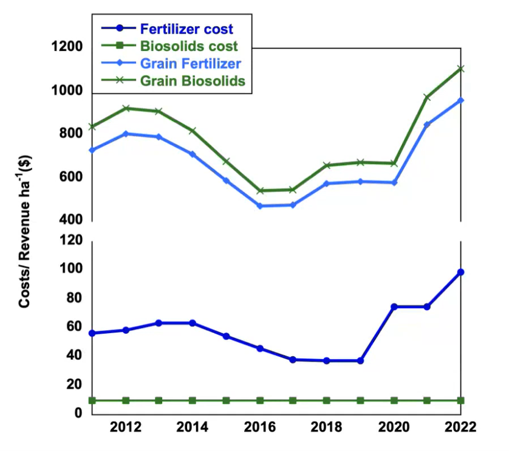
Cost and Yield Performance of Biosolids: Comparison with conventional fertilizer for dryland wheat in Washington State
This benefit is particularly relevant because synthetic fertilizer prices can change sharply with energy costs, trade restrictions, and geopolitical disruptions. According to the USDA Economic Research Service, fertilizer costs per acre for U.S. corn and wheat were 110% and 141% higher, respectively, in 2022 than their 2010–2019 averages. Prices later declined, but the World Bank notes that natural gas costs, export restrictions and changes in global trade remain sources of volatility.
Actual savings from using biosolids as fertilizer are site-specific. Farmers must consider nutrient availability, application rates, transport, storage, spreading, testing, and any need for supplemental fertilizer. When conditions are favorable, properly managed biosolids can replace part of a farm's purchased fertilizer and provide a more locally sourced nutrient supply.
Beyond these advantages, the land application of biosolids returns valuable nutrients and organic matter to the soil instead of sending them to a disposal site. This is especially important as phosphate rock is a finite resource, and many agricultural soils are losing organic carbon. Biosolids may help close these nutrient cycles, conserve resources, and support a more circular approach to wastewater and soil management.
Did You Know?
In 2023, global agricultural use of inorganic nitrogen, phosphorus, and potassium fertilizers totaled approximately 190 million tons of nutrients. Meeting this demand has significant resource implications: nitrogen fertilizer production consumes large amounts of fossil energy, while phosphorus depends on finite, geographically concentrated rock reserves. Given the scale and resource demands of fertilizer production, efficiently using and recovering nitrogen and phosphorus from waste streams can reduce reliance on newly manufactured or mined fertilizers.
Biosolids Fertilizer vs Synthetic Fertilizer and Other Organic Inputs
Fertilizer made from biosolids differs from synthetic fertilizers, composts, and livestock manure in terms of its source, composition, treatment, and regulation:
- Biosolids fertilizer is a sewage sludge that has undergone the required treatment and meets applicable standards for beneficial use. The term "biosolids" is especially common in the United States; other countries often use terms such as treated sewage sludge.
- Synthetic or conventional fertilizer is manufactured or processed from mined materials to supply specific nutrients in relatively standardized concentrations. It is generally more concentrated and predictable than biosolids, but usually contributes little or no organic matter to the soil.
- Biosolids compost is made by combining biosolids with carbon-rich bulking materials, such as wood chips or yard trimmings, and composting the mixture under controlled conditions. Composting can stabilize organic matter and reduce pathogens and odors, but it does not guarantee the removal of every chemical contaminant.
- Conventional compost is produced from decomposed organic materials such as food scraps, yard trimmings, crop residues or manure, without municipal sewage sludge as an ingredient. Its nutrient content is generally lower and less concentrated than that of fertilizer, so it is used primarily to add stable organic matter and improve soil properties. Its quality and contaminant profile depend on the feedstock and composting process.
- Manure comes from livestock rather than municipal wastewater. Its nutrient content and potential contaminants vary according to the animal species, feed, bedding, veterinary inputs, storage, and handling. Like biosolids, manure can supply nutrients and organic matter, but it is governed by different treatment and application requirements.
These materials are not necessarily interchangeable. Synthetic fertilizers provide precise, readily available nutrients, while biosolids, compost, and manure can also add organic matter and improve soil properties.
The most suitable option for applying to a specific type of land depends on crop requirements (if any), soil conditions, nutrient availability, transport costs, product quality, and applicable regulations.
Risks and Concerns Associated with Biosolids Used as Fertilizer
Biosolids can recycle valuable nutrients and organic matter, but they may also contain substances captured from households, hospitals, businesses, and industrial discharges. The types and concentrations of these substances vary considerably across wastewater systems and treatment processes. For this reason, biosolids should be evaluated using current testing, applicable regulations, and site-specific risk assessments rather than treated as a uniform product.
PFAS and Other Persistent Chemicals
Per- and polyfluoroalkyl substances (PFAS) are a large class of persistent synthetic chemicals used in products such as stain-resistant textiles, non-stick coatings, and food packaging. Because PFAS are widespread in consumer and industrial products, wastewater treatment plants may receive them from households, businesses, and industrial facilities.
Conventional wastewater treatment is not designed to destroy PFAS. Some PFAS bind to wastewater solids and can therefore accumulate in biosolids. Following land application, certain PFAS may persist in soil, migrate into groundwater or surface water, or be taken up by crops and livestock. The potential risk depends on factors including the specific compound and its concentration, application rate and history, soil and site conditions, and how people or animals may be exposed.
Regulation of PFAS in biosolids is still evolving. The European Union's PFAS action plan places greater emphasis on preventing PFAS releases at their source. It has already restricted several PFAS and introduced measures covering drinking water, industrial emissions, soil monitoring, and food-contact packaging. A proposal to restrict PFAS broadly as a group is also progressing through the EU regulatory process, although it has not yet become a general ban.
In the United States, the EPA's guidance to reduce PFAS risks in biosolids is under development, while individual states have introduced their own interim controls. Michigan, for example, requires PFAS testing before biosolids are land applied. Under its interim strategy, biosolids containing PFOA or PFOS at 100 micrograms per kilogram or more cannot be land applied. Concentrations from 20 to below 100 micrograms per kilogram trigger a reduced application rate or another state-approved risk-mitigation strategy, as well as source investigation and reduction measures.
These approaches show that addressing PFAS in biosolids requires both careful management of contaminated material and action to prevent these chemicals from entering wastewater systems in the first place.
Heavy Metals
Wastewater solids can contain metals such as arsenic, cadmium, copper, lead, mercury, nickel, selenium, and zinc. Some of these, including copper and zinc, are essential plant nutrients at low concentrations but can become harmful at high concentrations. Others, such as cadmium, lead and mercury, have no beneficial agricultural role and may persist in soil. Repeated applications can cause metals to accumulate, potentially affecting soil organisms, plant growth, livestock or human health.
Industrial pretreatment programs and tighter discharge controls have substantially reduced metal concentrations in many modern biosolids, but testing remains essential. In the United States, federal rules establish concentration and cumulative loading limits for specified metals in land-applied sewage sludge; the EPA's biosolids pollutant tables summarize these limits. Individual states and other countries may impose stricter requirements or regulate additional substances.
Pathogens and Odor
Untreated sewage sludge can contain disease-causing bacteria, viruses, protozoa, and parasitic worms. Treatment processes such as digestion, composting, heat drying, alkaline (or lime) stabilization, and more advanced digestion technologies are used to reduce or eliminate these organisms, but the required level of treatment and the permitted uses differ by biosolids class and jurisdiction.
In the United States, Class A biosolids must meet stricter pathogen-reduction criteria, while Class B biosolids may retain detectable pathogens and consequently require site restrictions, waiting periods and controlled public access. Poor treatment, inadequate monitoring, improper storage, or regrowth after treatment may increase the risk of exposure to pathogens. Following approved treatment processes, verifying indicator organisms, reducing vector attraction and observing crop-harvest and grazing restrictions are therefore important safeguards. The EPA provides a detailed overview of pathogen and vector-attraction control in sewage sludge.
Odor is another important concern when storing, transporting, or applying biosolids. It is mainly caused by volatile compounds released as organic matter and sulfur-containing materials break down, particularly when biosolids are insufficiently stabilized or become anaerobic during storage. Warm temperatures, long storage periods, and surface application without incorporation can make odors more noticeable. Although microorganisms produce many of these compounds, odor does not necessarily indicate the presence of pathogens, and pathogen-free biosolids are not automatically odor-free.
Odor potential can be substantially reduced through effective stabilization and the production of high-quality biosolids. Good storage and transport practices, prompt incorporation into soil where appropriate, suitable weather conditions, and adequate distance from neighboring properties can further limit odor impacts.
Did You Know?
Biosolids treated using thermal hydrolysis (THP), followed by anaerobic digestion, typically meet the US EPA requirements for Class A Exceptional Quality biosolids. THP uses high heat and pressure to break down and sanitize sludge, while the subsequent digestion stage establishes a new microbial community that further stabilizes organic matter.
This treatment combination also improves volatile solids destruction and generally produces biosolids with a soil-like or earthy odor. Utilities such as DC Water have used THP to produce high-quality biosolids, reducing odor-related impacts in densely populated areas while generating revenue from a commercial soil product.
Pharmaceuticals and Other Emerging Contaminants
Medicines, hormones, personal-care product ingredients, antimicrobial chemicals, flame retardants, microplastics and other contaminants can enter sewer systems and partition partly into wastewater solids. Treatment may break down some compounds, but others can remain in the finished biosolids. After land application, their behavior varies: some degrade relatively quickly, while others may persist, move through soil, affect soil organisms, or be taken up by plants.
The presence of a chemical does not automatically demonstrate a meaningful health risk; risk also depends on concentration, toxicity, environmental fate, and actual exposure. Nevertheless, many of these compounds are not routinely monitored or specifically limited by biosolids regulations, and significant knowledge gaps remain concerning the effects of chemical mixtures and repeated long-term applications.
A peer-reviewed critical review of pharmaceuticals and personal care products in sewage sludge concluded that their occurrence and behavior should be considered when biosolids are applied to soil. Source reduction, improved wastewater treatment, targeted monitoring, and continued research are central to managing this broad and evolving category.
Excess Nutrients
Applying biosolids based primarily to meet a crop's nitrogen requirements can supply more phosphorus than the crop needs, potentially leading to phosphorus accumulation in the soil and an increased risk of losses to waterways over time.
This risk can be mitigated through soil and biosolids testing, phosphorus-based application rates on high-phosphorus fields, rotation among suitable sites, setbacks and vegetated buffers, erosion control, and avoiding application before heavy rain or on frozen or saturated ground. Where phosphorus is already excessive, lower biosolids rates can be supplemented with nitrogen fertilizer, or technologies that recover phosphorus before land application can be considered.
The Role of Biosolids in a Circular Fertilizer System
The use of biosolids as fertilizer or soil amendment offers meaningful benefits but also requires careful management. When properly treated and applied, biosolids can recycle nitrogen, phosphorus, micronutrients, and organic matter; improve soil properties; support crop production and land reclamation; and, under suitable conditions, reduce fertilizer costs. Biosolids cannot fully replace mineral fertilizers given the scale of agricultural nutrient demand, but they can still make a valuable contribution at both farm and regional levels.
These benefits must be weighed against potential risks, including those associated with PFAS and other persistent chemicals. Whether biosolids are suitable for a particular use therefore depends on its source, treatment and quality, as well as the soil, crop, application rate, site conditions, and applicable regulations.
Ultimately, land application treats suitable biosolids not simply as a waste stream requiring disposal, but as a resource that can be returned to productive use. With effective source control, appropriate treatment, transparent testing and responsible application, biosolids can contribute to a more circular fertilizer system by supporting agriculture recovering and returning valuable nutrients and organic matter to productive use.